

Strategic Factors of Gen Z’s Leadership in Technology-Mediated Student Protests: Empirical Insights from the July Movement in Bangladesh
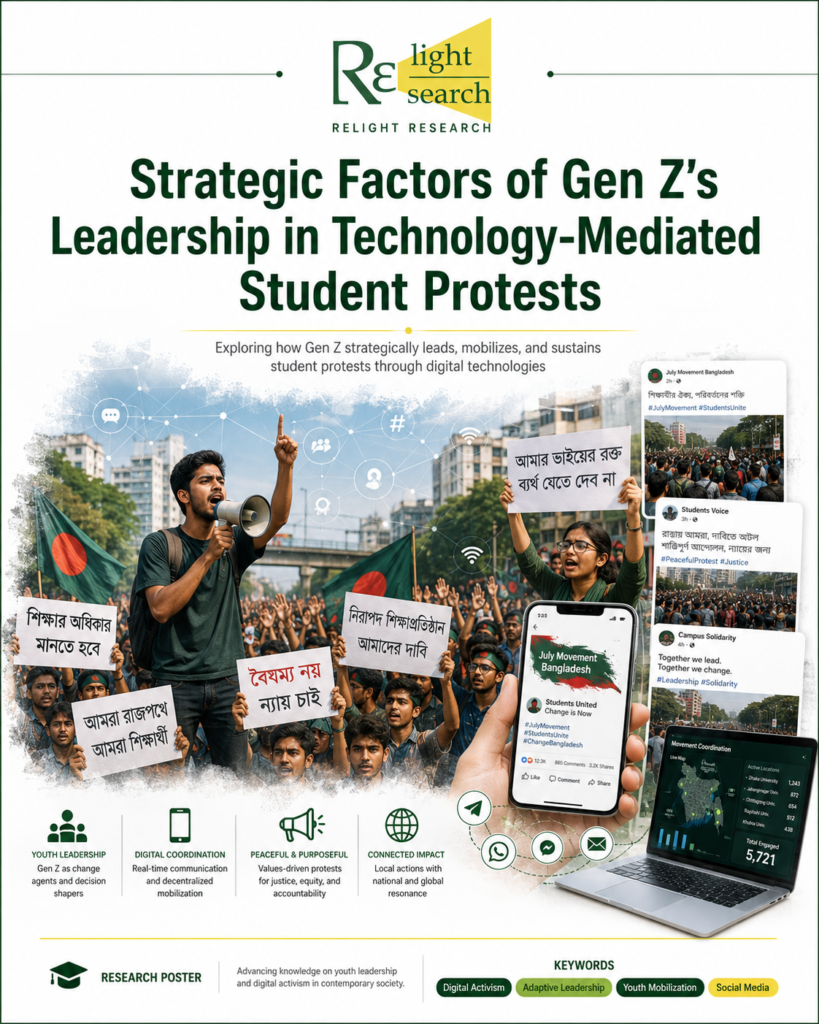
Authors:Muslima Zahan, Atikur Rahman Khan, and Golam Mathbor Affiliations:North South University, BangladeshMonmouth University, New Jersey, USA Published in: South Asian Journal of Social Sciences and HumanitiesVolume: 7, Issue 1, pp. 13–39Published: 5 February 2026DOI: 10.48165/sajssh.2026.7102 Description This study examines how Generation Z exercised leadership during the technology-mediated student protests of July–August 2024 in Bangladesh. Based on survey responses from 2,120 participants across schools, colleges, and universities, the research investigates how digital communication, collective intelligence, emotional engagement, networked leadership, transparency, and crisis management supported large-scale mobilization. Using Partial Least Squares Structural Equation Modelling, the study identifies Adaptive and Resilient Leadership as the central mechanism behind effective protest leadership. The findings show that crowdsourcing, value-based leadership, global connectivity, rapid information sharing, digital transparency, hashtags, viral campaigns, and narrative storytelling enabled decentralized coordination and sustained collective action. The research contributes to the understanding of digital-era leadership, youth activism, technology-mediated protest, and SDG 16 by presenting a conceptual framework explaining how Gen Z uses digital platforms to promote justice, participation, and stronger institutions. Keywords: Gen Z, technology-mediated protest, digital activism, adaptive leadership, social media, youth leadership, SDG 16, peace, justice, and strong institutions Download Full Research Paper
Environmental Burden and AI Ethics: Developing Quality Education
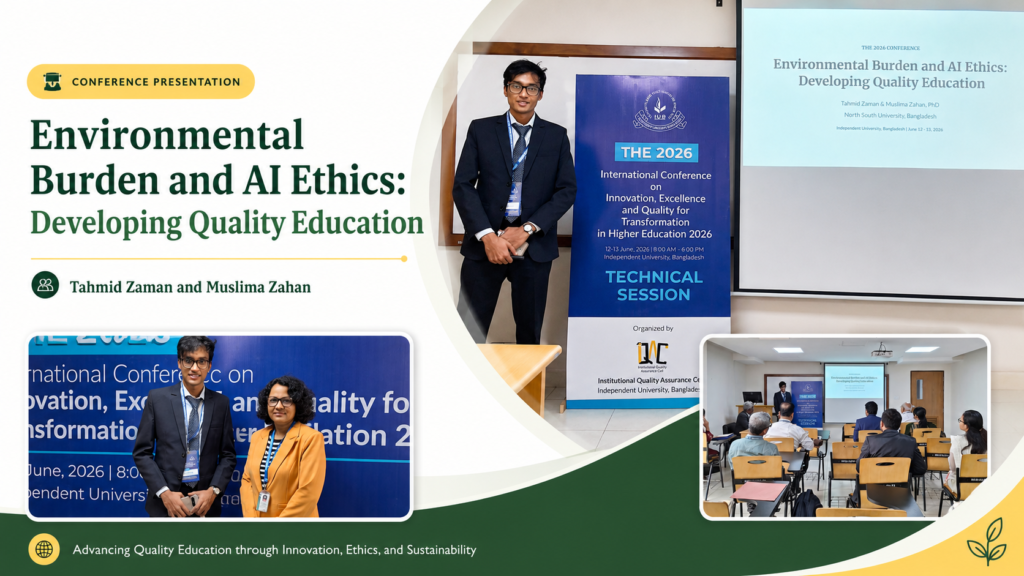
Authors: Tahmid Zaman and Muslima ZahanAffiliation: North South University, BangladeshConference: THE 2026Venue: Independent University, BangladeshDate: 12–13 June 2026 Generative AI tools such as ChatGPT are rapidly becoming part of higher education, reshaping how students learn, write, and complete academic tasks. However, the misuse of AI also raises serious concerns about learning quality, fairness, academic integrity, and institutional trust. This study examined the frequency and patterns of AI misuse among undergraduate students in Bangladesh and explored its impact on learning outcomes and the educational environment. Using a quantitative cross-sectional survey of 1,700 Bangladeshi undergraduate students, the research measured AI misuse, AI consumption intensity, learning outcomes, ethical awareness, and educational environmental burden. The paper also applied an adapted IPAT framework to explain AI misuse as a broader systemic burden rather than only individual misconduct. The findings show that AI use is now common and normalized among students, while misuse appears at a moderate level. The results partially support the idea that AI misuse increases educational environmental burden and that higher AI consumption can be linked with weaker learning outcomes. However, ethical awareness was not found to significantly moderate the relationship, suggesting that awareness alone may not be enough without proper institutional policies, assessment redesign, and responsible AI-use guidelines. Download Conference Proceedings
Customer Responsiveness and Rivalry: A Strategic Implication on Chinese Cuisine in Bangladesh

Authors: Dr. Muslima Zahan, Thamid Thasin , Samwati K Zahan , & Abir Khan Abstract: In Bangladesh, apart from Bangladeshi Dishes, Chinese cuisines achieves its first position to serve authentic and fusion dishes. From a Google form survey, n=1,922 and using snowball sampling, primary data is collected and analyzed to generate some descriptive statistics as well as two multivariate regression are conducted to accept null hypotheses. This study shows that Customer Responsiveness comprised with Authentication & Adaptation, Service Quality & Fair Price, Continuous Innovation, Diversification and Social Media engagement as well as Rivalry (intense competition) comprised with Innovators & Early Adopters, Early Majority, Mature Industry, Niche and Global Strategy have significant influence on the strategic shift, customer retention, competition and sustainable operation.