

ReLight Research continues to foster impactful academic contributions through conference presentations and peer-reviewed publications. Below, explore our most recent research presented at international conferences and published across scholarly platforms.
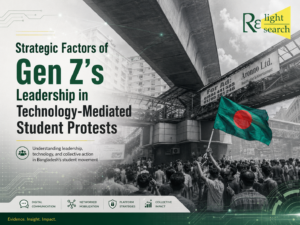
Strategic Factors of Gen Z’s Leadership in Technology-Mediated Student Protests
Empirical Insights from the July Movement in Bangladesh
Authors:
Muslima Zahan, Atikur Rahman Khan, and Golam Mathbor
Affiliations:
North South University, Bangladesh
Monmouth University, New Jersey, USA
Published in: South Asian Journal of Social Sciences and Humanities
Volume: 7, Issue 1, pp. 13–39
Published: 5 February 2026
DOI: 10.48165/sajssh.2026.7102
Description
This study examines how Generation Z exercised leadership during the technology-mediated student protests of July–August 2024 in Bangladesh. Based on survey responses from 2,120 participants across schools, colleges, and universities, the research investigates how digital communication, collective intelligence, emotional engagement, networked leadership, transparency, and crisis management supported large-scale mobilization.
Using Partial Least Squares Structural Equation Modelling, the study identifies Adaptive and Resilient Leadership as the central mechanism behind effective protest leadership. The findings show that crowdsourcing, value-based leadership, global connectivity, rapid information sharing, digital transparency, hashtags, viral campaigns, and narrative storytelling enabled decentralized coordination and sustained collective action.
The research contributes to the understanding of digital-era leadership, youth activism, technology-mediated protest, and SDG 16 by presenting a conceptual framework explaining how Gen Z uses digital platforms to promote justice, participation, and stronger institutions.
Keywords: Gen Z, technology-mediated protest, digital activism, adaptive leadership, social media, youth leadership, SDG 16, peace, justice, and strong institutions
Conference Presentations
Featured Conference Papers & Projects
Each conference entry includes project title, authorship, abstract, keywords, and download links. Visuals (charts, presentation thumbnails, or conference images) are encouraged for better engagement.
All publications are organized in a standardized format for transparency, accessibility, and ease of reference.
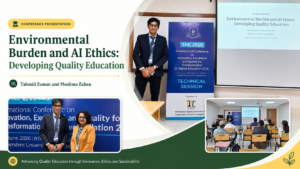
Environmental Burden and AI Ethics: Developing Quality Education
Authors: Tahmid Zaman and Muslima Zahan
Affiliation: North South University, Bangladesh
Conference: THE 2026
Venue: Independent University, Bangladesh
Date: 12–13 June 2026
Generative AI tools such as ChatGPT are rapidly becoming part of higher education, reshaping how students learn, write, and complete academic tasks. However, the misuse of AI also raises serious concerns about learning quality, fairness, academic integrity, and institutional trust.
This study examined the frequency and patterns of AI misuse among undergraduate students in Bangladesh and explored its impact on learning outcomes and the educational environment. Using a quantitative cross-sectional survey of 1,700 Bangladeshi undergraduate students, the research measured AI misuse, AI consumption intensity, learning outcomes, ethical awareness, and educational environmental burden. The paper also applied an adapted IPAT framework to explain AI misuse as a broader systemic burden rather than only individual misconduct.
The findings show that AI use is now common and normalized among students, while misuse appears at a moderate level. The results partially support the idea that AI misuse increases educational environmental burden and that higher AI consumption can be linked with weaker learning outcomes. However, ethical awareness was not found to significantly moderate the relationship, suggesting that awareness alone may not be enough without proper institutional policies, assessment redesign, and responsible AI-use guidelines.
Download Conference Proceedings

Job Structure and Employee Productivity for Work-Life Balance
A Case Study on Beximco Pharmaceuticals Ltd.
-
Authors:
Thamid Thasin¹ (BBA Final Semester, North South University)
Dr. Muslima Zahan² (Associate Professor, NSU, SBE)
thamidthasin@northsouth.edu, muslima.zahan@northsouth.edu -
Abstract:
Employees are productive during certain times of the day, with productivity usually highest
in the first few hours of the workday and lower after lunch. This study focuses on how
adjusting job structures, like adding flexible work options or rotating employees, could help
maintain constant productivity and improve work-life balance(WLB). Results show that
flexible hours, such as part-time schedules, or flexible working hours, are linked to higher job
satisfaction and less absenteeism. Replacing employees with a job pool after a set time also
helps prevent drops in productivity caused by fatigue and repetitive work. Data from 31
employees, gathered through a survey, indicates a strong connection between flexible work
policies and satisfaction in the pharmaceuticals industry. This study shows a strong
relationship between WLB and productivity on reforming the job structure with an R-square
of 0.9516, indicating that changes in job structure could significantly enhance both
productivity and work-life balance. The study recommends that managers, especially in highdemand sectors like pharmaceuticals, adopt flexible working hours, job rotations, and
structured replacement pools to support employee satisfaction and productivity. -
Keywords:
Job structure, employee productivity, work-life balance, pharmaceuticals -
Presented At:
International Conference on Resilience and Sustainable Performance (ICRSP 2024)
December 6–7, 2024 | Murshidabad, West Bengal, India
PDF / Link: Download PDF
DOI: doi.org/10.xxxx/relight2025.001
Global Strategic Planning: Feedback from the Automobile Industry
-
Authors:
Dr. Muslima Zahan
Thamid Thasin
Samawati K. Zahan -
Abstract:
Introduction: Global Vehicle production exceeds 80-million-unit recent years, where China
alone accounts for over 30% of global vehicle sales. Along with traditional automakers such as Toyota,
Volkswagen, General Motors, Ford, Honda, and Hyundai-Kia, electric vehicle (EV) manufacturers
like Tesla, BYD, NIO and Rivian (with autonomous driving using AI and sensor technology) are
leading the charge. The EV market is projected to grow at a compound annual growth rate (CAGR) of
over 20% through 2030. The rise of connected cars, ride-sharing platforms and subscription based
model both for luxury and commercial brands, with increased focus on carbon emissions reduction,
recycled materials and adopting circular economy principles, car companies must rehearse it strategic
planning for profit protection and market expansion; regional and global, as well as prepare to face
supply chain challenges (semi-conductor shortage), technological disruption and economic
uncertainty (fuel price, inflation)
Purpose of the research: Based on the diagram of strategic planning process, this study
outlines all seven levels/categories of strategies for automobile industries globally.
Design/Methodology: The is exploratory research. Primarily 50 random companies are
selected, along the websites, secondary data are sought and tabulated. Finally, tables and charts are
calculated and placed for the pertinent strategies.
Results/Findings: The investigation provides the strategic framework for seven categories of
strategies such as Functional strategy (efficiency, quality, innovation, and customer responsiveness),
Business level strategy (cost leadership, differentiation, focus differentiation, niche and best), Global
strategy (standardization, transnational, international, and localization), Technological strategy
(Licensing or Strategic Alliances), Corporate Level Strategy (Merger, Acquisition, Diversification),
Ethical & Sustainable strategy (ethical, eco-branding and eco-efficient) and, finally, the
Organizational strategy (structure, culture and control) for car manufacturing companies.
Practical Implications and Conclusion: To phase out the internal combustion engines (ICE)
and the rise of Mobility-as-a-Service (MaaS), the strategic feedback could enable the industry to face
future challenges comprehensively. -
Keywords:
Strategic planning, global strategy, automobile industry, sustainability, electric vehicles -
Presented At:
International Conference on Business & Economic Development (ICBED 2025)
7–8 April, 2025 | Conference Proceedings by Centre for Business & Economic Research
Published in: The Business and Management Review, Vol 16, No 1 -
Download PDF: Download PDF
-
DOI: doi.org/xxxxxx
Search, Filter & Access Tools
- Filter by Year, Author, or Research Area
- Search titles or keywords directly
- Download PDFs for personal or academic use
- DOI links available where registered
Want to Contribute?
We accept research submissions and working papers throughout the year. If you’d like to contribute your work to ReLight Research, please visit our Call for Papers section or contact editor@relightresearch.org