

Authors:
Muslima Zahan, Atikur Rahman Khan, and Golam Mathbor
Affiliations:
North South University, Bangladesh
Monmouth University, New Jersey, USA
Published in: South Asian Journal of Social Sciences and Humanities
Volume: 7, Issue 1, pp. 13–39
Published: 5 February 2026
DOI: 10.48165/sajssh.2026.7102
Description
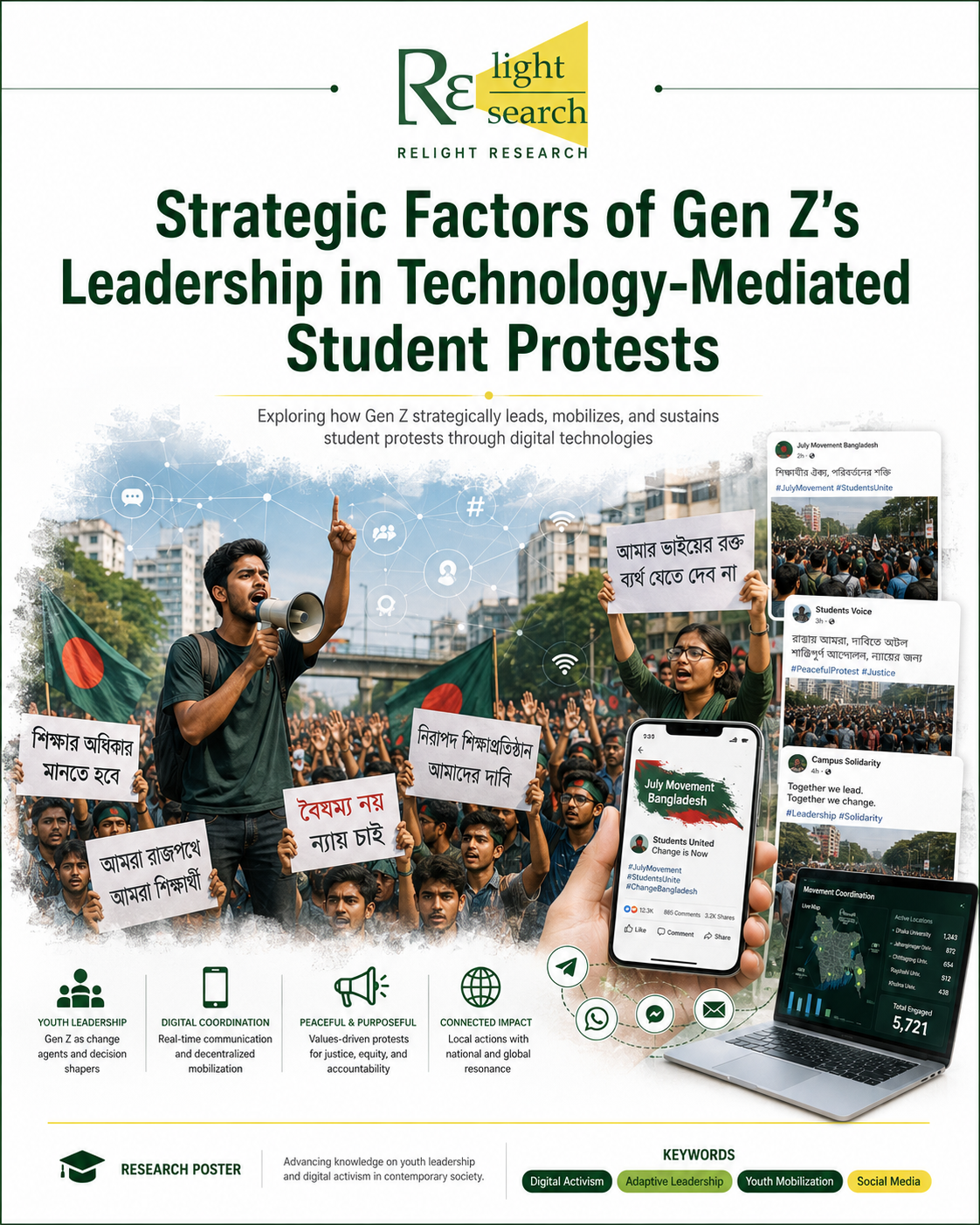
This study examines how Generation Z exercised leadership during the technology-mediated student protests of July–August 2024 in Bangladesh. Based on survey responses from 2,120 participants across schools, colleges, and universities, the research investigates how digital communication, collective intelligence, emotional engagement, networked leadership, transparency, and crisis management supported large-scale mobilization.
Using Partial Least Squares Structural Equation Modelling, the study identifies Adaptive and Resilient Leadership as the central mechanism behind effective protest leadership. The findings show that crowdsourcing, value-based leadership, global connectivity, rapid information sharing, digital transparency, hashtags, viral campaigns, and narrative storytelling enabled decentralized coordination and sustained collective action.
The research contributes to the understanding of digital-era leadership, youth activism, technology-mediated protest, and SDG 16 by presenting a conceptual framework explaining how Gen Z uses digital platforms to promote justice, participation, and stronger institutions.
Keywords: Gen Z, technology-mediated protest, digital activism, adaptive leadership, social media, youth leadership, SDG 16, peace, justice, and strong institutions