

Environmental Burden and AI Ethics: Developing Quality Education
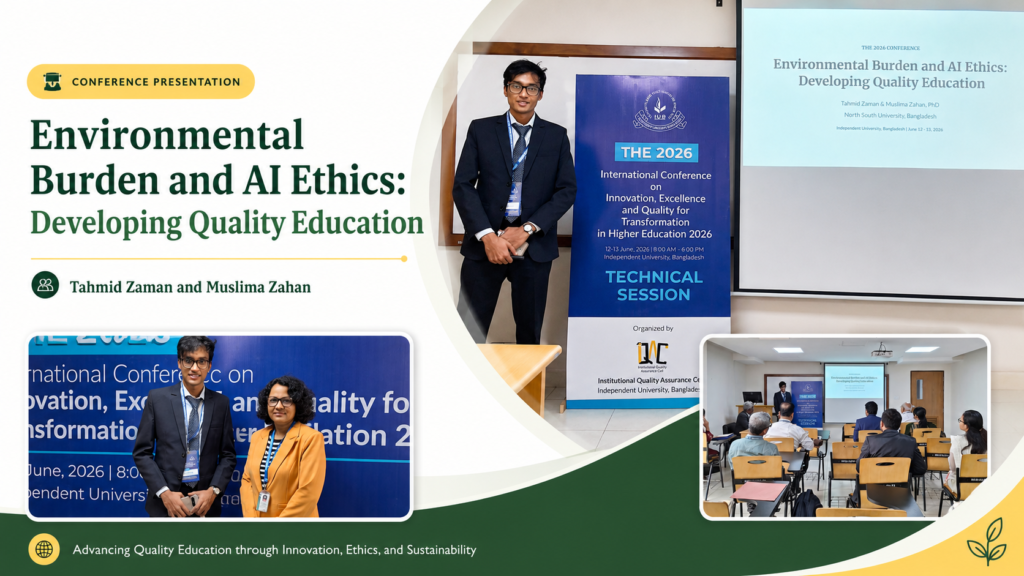
Authors: Tahmid Zaman and Muslima ZahanAffiliation: North South University, BangladeshConference: THE 2026Venue: Independent University, BangladeshDate: 12–13 June 2026 Generative AI tools such as ChatGPT are rapidly becoming part of higher education, reshaping how students learn, write, and complete academic tasks. However, the misuse of AI also raises serious concerns about learning quality, fairness, academic integrity, and institutional trust. This study examined the frequency and patterns of AI misuse among undergraduate students in Bangladesh and explored its impact on learning outcomes and the educational environment. Using a quantitative cross-sectional survey of 1,700 Bangladeshi undergraduate students, the research measured AI misuse, AI consumption intensity, learning outcomes, ethical awareness, and educational environmental burden. The paper also applied an adapted IPAT framework to explain AI misuse as a broader systemic burden rather than only individual misconduct. The findings show that AI use is now common and normalized among students, while misuse appears at a moderate level. The results partially support the idea that AI misuse increases educational environmental burden and that higher AI consumption can be linked with weaker learning outcomes. However, ethical awareness was not found to significantly moderate the relationship, suggesting that awareness alone may not be enough without proper institutional policies, assessment redesign, and responsible AI-use guidelines. Download Conference Proceedings